Article by Shahan Rizvi
There are cars you buy because everyone tells you they are great.
Then there are cars you discover almost by accident — the kind that make you look twice at the spec sheet and say, “Wait… this thing has HOW much horsepower?”
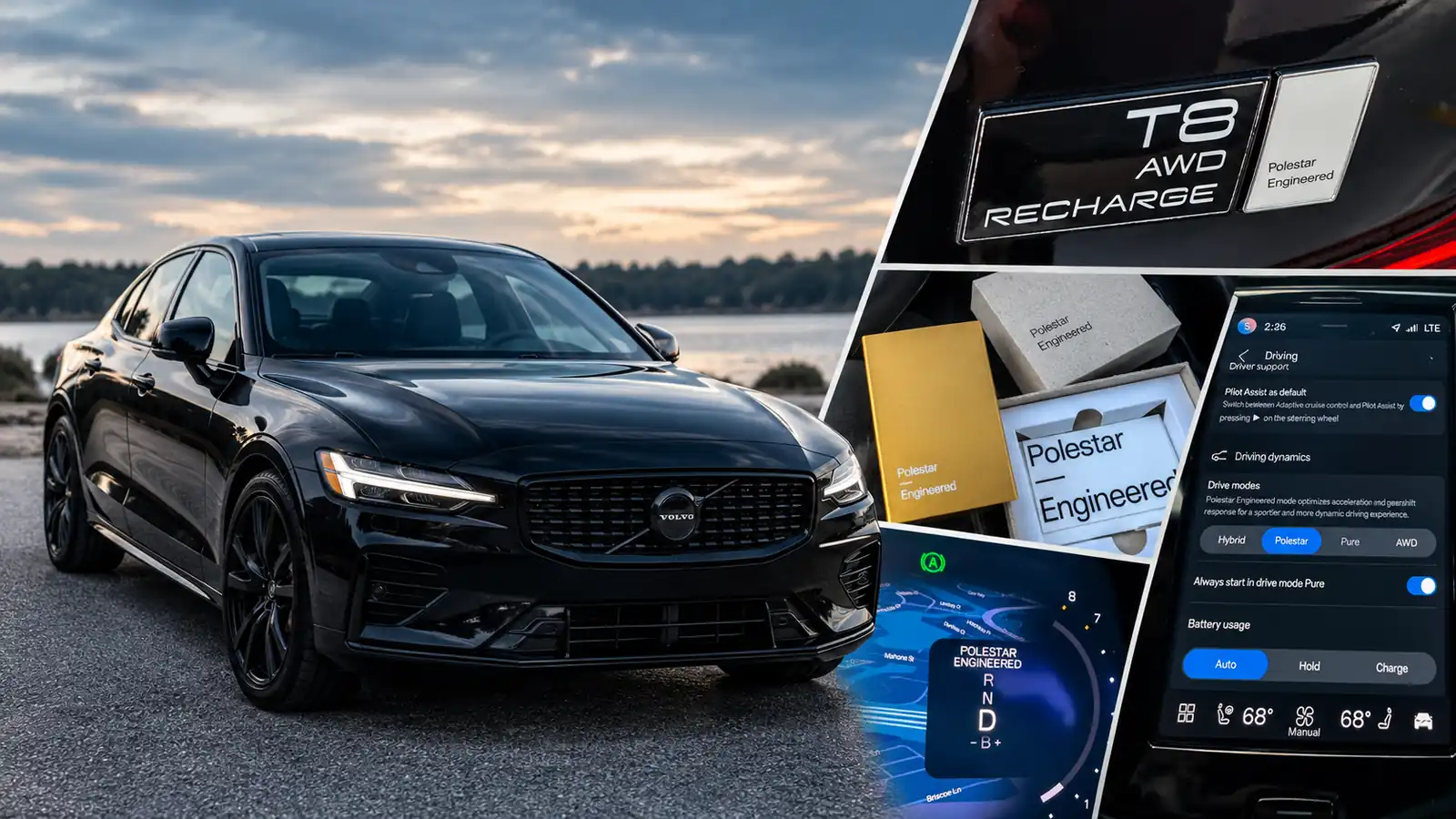
That was my 2024 Volvo S60 Recharge.
I bought mine used for roughly $38,000, and I honestly believe it may be one of the most overlooked performance bargains on the used-car market right now.
A black-on-black luxury sedan with 455 horsepower, all-wheel drive, a 4.3-second 0–60 mph time and plug-in hybrid capability does not sound like something that should be sitting in the high-$30,000 range.
But here we are.
And after coming out of a 2023 Acura TLX Type S, the S60 Recharge has completely changed the way I think about what a daily-driver performance car can be.
How I Went From an Acura TLX Type S to a Volvo
This story actually starts with a car I really liked.
My 2023 Acura TLX Type S looked incredible, had the performance sedan attitude I wanted, and packed a 355-horsepower turbocharged V6 into a relatively understated body.
I paid about $44,500 for it.
A year later, I had put more than 20,000 additional miles on it.
It was fast. It was fun.
But ownership started becoming a little harder to justify.
The biggest issue was fuel.
I was getting roughly 19–21 mpg, and there were weeks when I was filling the Acura twice. At one point, I was spending around $140 a week on gasoline.
Then there was the transmission.
The transmission in my TLX Type S ultimately failed and was replaced under warranty. That’s the kind of experience that makes you start thinking differently about keeping a high-performance car well past its warranty period.
I could have bought an extended warranty for around $1,500, which would have helped reduce my exposure to another major mechanical repair.
But it wouldn’t address another concern that had become increasingly difficult for me to ignore:
theft.
The Theft Problem Was the Final Straw
I started looking more seriously into TLX theft after seeing stories from other owners.
Then the data really got my attention.
According to Highway Loss Data Institute data covering 2022–2024 model-year vehicles, the Acura TLX AWD had a whole-vehicle theft claim frequency about 21 times the average for passenger vehicles.
That doesn’t mean every TLX is going to get stolen. It does mean the insurance data shows an unusually high theft frequency for the model.
And then I saw a post in a TLX group about a Type S being stolen in Gaithersburg. The owner reportedly watched and recorded the theft from his apartment deck.
That was the moment where I thought:
Okay. Maybe this isn’t the car for me anymore.
I also had just paid about $1,000 out of pocket for the 50,000-mile maintenance.
At that point, I started asking myself a very simple question:
Was keeping the TLX Type S still the smartest financial decision for my situation?
And that question sent me down a rabbit hole.
Enter the Volvo S60 Recharge
I started researching plug-in hybrids.
I wanted something that could give me the performance I enjoyed in the Acura without forcing me to live at the gas pump.
I looked at different models, read ownership complaints, dug through reliability discussions and compared the numbers.
Then I stumbled onto the Volvo S60 Recharge.
And I had to read the specifications more than once.
455 horsepower.
Wait… a Volvo S60 has 455 horsepower?
The 2024 S60 Recharge combines a 312-horsepower gasoline engine with a 143-horsepower electric motor, producing a manufacturer-rated 455 horsepower and 523 lb-ft of torque. Volvo lists 0–60 mph in 4.3 seconds.
That is not exactly what comes to mind when someone says “Volvo.”
And that’s precisely why I think this thing is such a sleeper.
The Sleeper Factor Is Real
The first time I saw one in person, I knew immediately what I wanted.
Black exterior.
Black interior.
Understated Volvo styling.
Nothing screaming performance car.
No giant wing.
No obnoxious exhaust.
No neon color.
Just a sophisticated Swedish sedan.
Then you hit the accelerator.
And the personality completely changes.
The S60 Recharge doesn’t look like a 4.3-second car.
But it is.
The electric motor gives you immediate torque while the gasoline engine brings the horsepower. The result is an AWD sedan that feels dramatically quicker than its styling suggests.
And through corners?
This thing is seriously fun.
I describe it to my friends as:
“It eats corners like it’s Tokyo Drift.”
Maybe that’s a slight exaggeration.
Maybe.
But the combination of instant electric torque, AWD and the S60’s chassis makes it feel considerably more athletic than the traditional Volvo stereotype.
Then We Started Talking Money
This is where the deal got really interesting.
The Volvo was listed at about $38,500.
The dealer eventually agreed to sell me the car for $37,519.
And then we talked about my Acura.
With approximately 49,500 miles on it, they initially offered me around $38,000.
I told them they could do better.
They eventually gave me:
$40,000 for my TLX Type S.
That changed the entire equation.
Remember, I had paid about $44,500 for the Acura a year earlier.
I had put more than 20,000 miles on it, dealt with the transmission replacement, paid for maintenance and dealt with the anxiety surrounding the theft issue.
Yet I was only taking roughly a $4,500 hit in depreciation after that year of ownership.
For a 400-ish horsepower luxury performance sedan driven another 20,000-plus miles, I was pretty happy with how that part of the transaction worked out.
The numbers finally made sense.
I financed roughly $14,000, didn’t put additional money down, and my payment went from approximately $350 to $275 a month.
Even better:
My new S60 had only about 29,400 miles.
So psychologically, it felt like I had just hit the reset button.
I jokingly call it my:
20,000-mile restart.
I traded a car with almost 50,000 miles for one with under 30,000.
Same general performance-car category.
Less fuel consumption.
Lower payment.
And a completely different ownership experience.
Then I Discovered Polestar
This was the part I really wasn’t expecting.
I learned that my S60 Recharge was eligible for the Polestar Engineered Optimization.
For people unfamiliar with Volvo terminology, there are two different things that can cause confusion here.
Polestar is the Swedish performance/electric-car brand associated with Volvo’s history, while Polestar Engineered Optimization is also the name of a software performance upgrade available for certain Volvo models.
The upgrade isn’t just a badge.
Polestar says its optimization modifies powertrain characteristics including engine performance, throttle response, gearshift speed and precision, while also changing shift behavior and other drivetrain characteristics. Polestar states that the upgrade is installed by a Volvo retailer and does not invalidate the vehicle’s original warranty.
For my S60, the upgrade cost about $1,560, and I rolled it into the deal.
The Polestar Upgrade Made This Car Even More Fun
The difference wasn’t that the car suddenly became some completely different vehicle with 100 additional horsepower.
It’s more subtle than that.
And that’s actually what makes it cool.
The car feels more eager.
The throttle feels sharper.
The transmission behavior feels more aggressive.
Downshifts feel quicker and more purposeful.
Instead of the car feeling like a comfortable luxury sedan that happens to be very fast, it starts feeling like a performance sedan that happens to be extremely comfortable.
Polestar describes its optimization as a drivetrain-focused performance upgrade designed to make the car more responsive and dynamic.
And in my experience?
It works.
My S60 now absolutely rips.
And Volvo Made the Experience Fun
The dealership experience surrounding the Polestar installation was also surprisingly cool.
After getting the upgrade, I received a little Polestar package containing:
A Polestar badge
A certificate of authenticity
A gold-colored Polestar card holder/wallet
Polestar stickers
It sounds like a small thing, but I liked it.
Instead of just paying for software and having someone plug a computer into the car, there was an actual sense that I had added something special to the car.
The certificate was especially cool because it documents that the car received the Polestar optimization.
And now the car has that little Polestar badge that basically tells car people:
There’s something different about this one.
Wait… Isn’t Polestar a Chinese Company?
This part is actually pretty fascinating.
Volvo is a Swedish automotive brand, but Volvo Cars has been controlled by Zhejiang Geely Holding Group, a Chinese automotive group, since Geely acquired Volvo Cars from Ford in 2010.
Polestar also has deep ownership and financial ties to Geely.
The corporate structure has changed over time, so it’s more accurate to say that Geely is the major controlling force behind both Volvo Cars and Polestar, rather than simply saying “Volvo owns Polestar.”
As of 2026, Volvo Cars holds approximately 19.9% of Polestar, while Geely Sweden Holdings has continued providing significant financial backing to Polestar.
And honestly, that’s part of what makes the whole ecosystem interesting.
Volvo gives you the understated Scandinavian luxury.
Polestar brings the performance DNA.
Geely sits behind the broader corporate structure.
And somehow the result is this ridiculously fast plug-in hybrid sedan that most people have never heard of.
The Gas Mileage Is Where This Car Gets Crazy
This is probably my favorite part of the entire ownership experience.
When I picked the car up, the dealer had filled the gas tank.
The car had roughly 29,400 miles.
I drove it all the way to about 30,100 miles before I needed to fill the tank.
That’s roughly 700 miles of driving.
And that was with me charging the car every night and using the electric range.
The EPA rates the 2024 S60 T8 Recharge at approximately 41 miles of electric range, with a 74 MPGe combined rating and 31 mpg combined on gasoline operation.
In my actual first experience, once the electric miles were factored in, I was pushing toward 800 miles of total travel between gas fill-ups.
That’s insane compared with what I was used to in the Acura.
Remember:
The TLX could drink enough fuel that I was occasionally filling up twice in one week.
The S60 Recharge makes it entirely realistic for me to go weeks between gas station visits depending on how much I’m charging and how I drive.
That’s the whole point of a plug-in hybrid.
You don’t have to choose between electric and gasoline.
You get both.
And the Technology Is Seriously Good
The tech in this Volvo surprised me almost as much as the performance.
One of my favorite features is having Google built directly into the car.
Google Maps is integrated into the infotainment system, which means I don’t have to depend on Apple CarPlay every time I want navigation.
And yes, the car still supports CarPlay.
But having Google Maps built into the vehicle makes the whole experience feel more like using a modern device than using a traditional car navigation system.
The interface is clean, the screen is large, and the Google ecosystem integration makes a lot of the car’s functions feel surprisingly intuitive.
There’s something strangely satisfying about sitting inside what looks like a restrained Scandinavian luxury sedan while the car quietly tells you where to go, manages the battery and then launches itself toward the next stop with 455 horsepower.
I Spent a LOT of Time Researching This Purchase
I didn’t just randomly trade the Acura for a Volvo.
I went down the rabbit hole.
Before buying, I researched common S60 Recharge ownership complaints, reliability concerns, transmission and transfer-case issues, theft statistics, long-term ownership costs and the resale equation between keeping my Acura and moving into the Volvo.
I even looked into the charging setup in my garage to make sure the existing 50-amp outlet and Volvo charging equipment were compatible.
I also spent time comparing the economics of the trade itself — what my Acura was worth, what I owed, what an extended warranty would cost and how the numbers would look if I kept the TLX to around 95,000 miles.
That research ultimately made me realize something:
There wasn’t going to be a perfect car.
Every car has compromises.
The trick is finding the compromises that fit your life.
For me, the biggest problem with the Acura had become fuel cost, theft exposure and the anxiety of owning a high-performance sedan with expensive components after already experiencing a transmission failure.
The Volvo solved a different set of problems.
Is the S60 Recharge Perfect?
No.
And I’m not pretending it is.
It’s still a complicated plug-in hybrid with a turbocharged gasoline engine, electric motor, high-voltage battery system and AWD architecture.
That is a lot of technology.
There are also fewer of these cars on the road than traditional luxury sedans, meaning ownership knowledge and parts availability aren’t necessarily going to be as straightforward as they are with something like a Honda Accord.
But for what I paid?
It’s difficult to ignore the combination.
455 horsepower.
4.3 seconds to 60 mph.
AWD.
Plug-in capability.
Approximately 41 miles of EPA electric range.
Luxury interior.
Google built-in.
Polestar optimization available.
And the fact that the car looks like a Volvo your neighbor might drive to work.
That’s the definition of a sleeper.
The Most Underrated Part: Nobody Knows What This Thing Is
This might be the best part.
People know BMW.
People know Mercedes-AMG.
People know Audi S and RS cars.
People know the Acura Type S.
But tell someone you drive a Volvo S60 Recharge, and the response is usually:
“Is that the electric one?”
Then you tell them:
455 horsepower.
0–60 in 4.3 seconds.
And suddenly their face changes.
That’s what I love about this car.
It’s fast without needing everyone to know it’s fast.
It’s luxurious without screaming luxury.
It can commute on electricity.
It can run on gasoline.
And when you put your foot down, it doesn’t behave like the sleepy Volvo people imagine.
My 2026 Car Purchase
I honestly didn’t expect to end up in a Volvo.
The Acura TLX Type S was supposed to be the car I’d keep.
But after a transmission replacement, high fuel costs, expensive maintenance and seeing the theft statistics, I started asking whether I was getting enough value out of it.
Trading it while it still had strong equity turned out to be the opportunity.
I got $40,000 for a car I paid approximately $44,500 for a year earlier.
I moved into a 2024 Volvo S60 Recharge with about 29,400 miles.
My payment dropped from around $350 to $275.
I effectively got my mileage reset by roughly 20,000 miles.
I added the Polestar optimization.
And instead of visiting the gas station constantly, I can charge at home and go dramatically longer between fill-ups.
That’s why, for me, the 2024 Volvo S60 Recharge has become something I didn’t even realize I was looking for:
A genuine 455-horsepower sleeper that I can actually live with every day.
And at the high-$30,000 price point on today’s used market, that’s a combination I think more car enthusiasts need to know about.
Because somewhere between the BMWs, Audis, Mercedes and performance Acuras sits a quiet black Volvo sedan that can embarrass a lot of cars while sipping electricity on the way home.
And almost nobody is talking about it