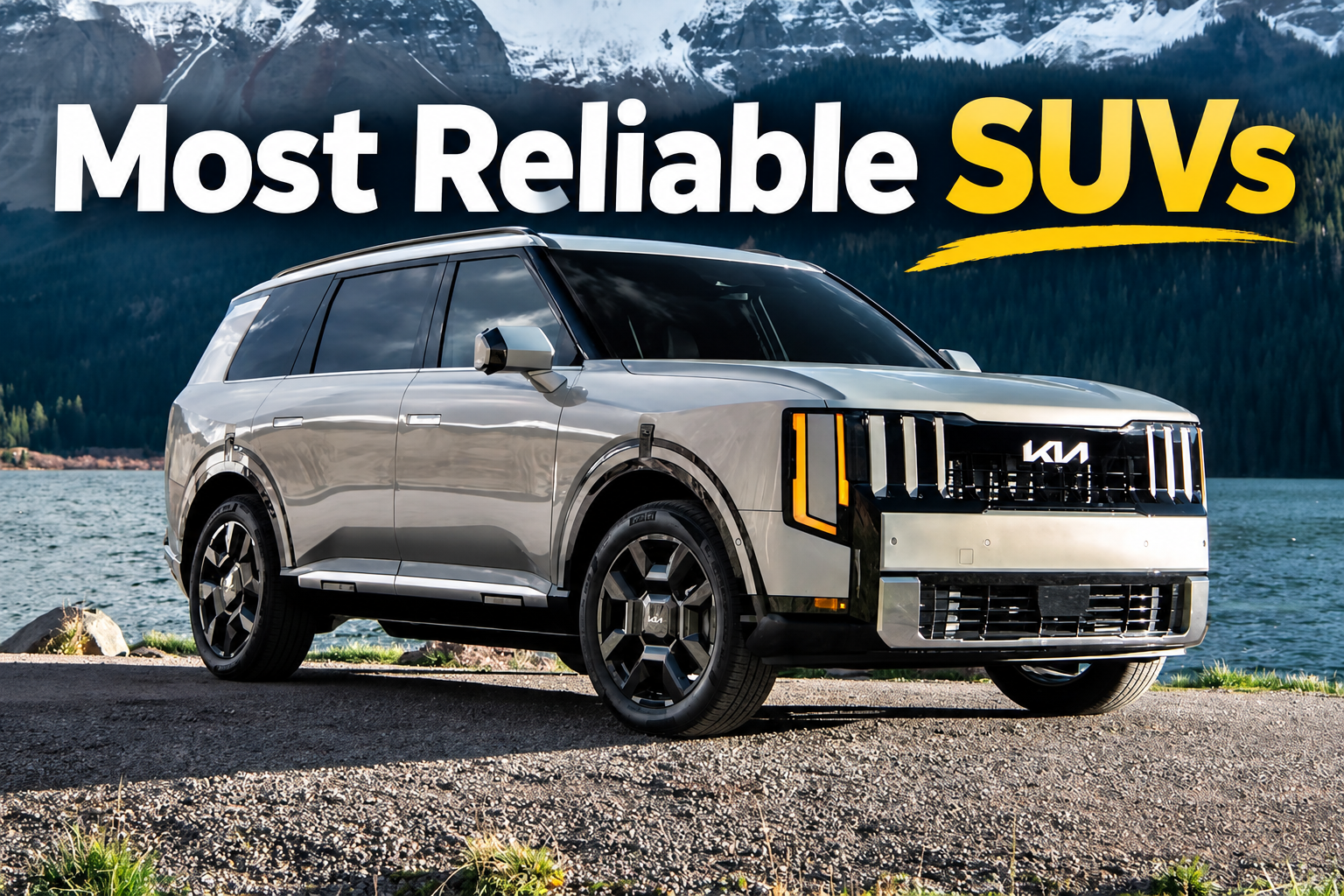
Buying an SUV is a big investment, and reliability should be near the top of your checklist. A vehicle that looks great in the showroom means little if it spends too much time in the repair shop.
The good news is that several 2026 SUVs stand out for predicted reliability, offering buyers a better chance of enjoying years of relatively trouble-free driving.
For shoppers, that makes reliability more useful than simply looking at a brand’s reputation. Toyota, Honda and Lexus may have long-standing reputations for durability, but the most reliable SUVs for you depends on the individual model, powertrain, vehicle generation and intended use.
Most Reliable SUVs for 2026 at a Glance
| Rank | SUV | Best For |
|---|---|---|
| 1 | Buick Encore GX | Overall reliability |
| 2 | Ford Bronco Sport | Off-road capability |
| 3 | Hyundai Venue | Budget buyers |
| 4 | Chevrolet Trailblazer | Families |
| 5 | Cadillac XT5 | Luxury and safety |
| 6 | BMW X6 | Luxury and performance |
| 7 | Audi Q3 | Small luxury SUV buyers |
| 8 | Ford Escape Hybrid | Fuel economy |
| 9 | Ford Escape | Practical commuting |
| 10 | Kia Seltos | Value |
What Is the Most Reliable SUV in 2026?
The Buick Encore GX takes the top spot in this ranking with a predicted reliability score of 90 out of 100.
That puts it near the top of “Great” reliability category.
It isn’t perfect. Rear-seat and cargo space are less generous than some competitors, and the three-cylinder engine isn’t designed to deliver thrilling acceleration. But if your priority is finding a reliable small SUV for daily driving, the Encore GX deserves serious consideration.
1. Buick Encore GX
Reliability Score: 90/100
The Buick Encore GX is the most reliable SUV in this 2026 ranking, making it an appealing choice for drivers who want a small crossover with a more upscale feel.
Its biggest strengths are comfort, easy maneuverability and a relatively refined cabin. The front seats are comfortable, while the available all-wheel-drive system gives buyers an option for improved traction in poor weather.
The trade-off is interior space. The second row and cargo area aren’t particularly generous compared with some rivals. The Encore GX therefore makes the most sense for individuals, couples and smaller families rather than buyers who regularly carry several adults or lots of cargo.
Why choose the Buick Encore GX?
- Excellent predicted reliability
- Comfortable ride
- Upscale cabin
- Available all-wheel drive
- Easy to maneuver in urban environments
- Good fuel economy for its class
Best for: Buyers who want a small, comfortable SUV with strong reliability.
2. Ford Bronco Sport
Reliability Score: 88/100
The Ford Bronco Sport proves that a reliable SUV doesn’t have to be boring.
Unlike many small crossovers designed primarily for paved roads, the Bronco Sport offers genuine off-road capability. Higher trims and the available Sasquatch package make it particularly attractive to drivers who regularly encounter dirt, mud, snow or rough terrain.
Its compact dimensions also make it easier to maneuver in cities than a full-size off-roader.
The downside is that its rugged suspension can make the ride less comfortable on normal pavement. The base engine also isn’t particularly powerful.
Still, its combination of reliability, utility and off-road capability makes the Bronco Sport one of the most interesting choices on this list.
Best for: Drivers who want an adventure-ready small SUV without giving up reliability.
3. Hyundai Venue
Reliability Score: 86/100
The Hyundai Venue is one of the strongest options for buyers shopping on a tight budget.
It doesn’t try to be a luxury SUV or a performance vehicle. Instead, the Venue focuses on the fundamentals: affordable pricing, straightforward operation, useful technology and good predicted reliability.
Its small size makes it particularly easy to park and maneuver around crowded cities.
The biggest compromise is space. Rear-seat and cargo room are limited, while acceleration is adequate rather than exciting.
Hyundai’s lengthy warranty coverage is another major advantage for budget-conscious buyers. The combination of a relatively low purchase price and long warranty coverage makes the Venue particularly attractive to shoppers who want to minimize financial risk.
Best for: First-time SUV buyers, city commuters and budget-conscious shoppers.
4. Chevrolet Trailblazer
Reliability Score: 88/100
The Chevrolet Trailblazer punches above its size when it comes to interior practicality.
Although it’s classified as a subcompact SUV, the Trailblazer offers surprisingly useful passenger space, particularly for rear-seat occupants. That makes it one of the more family-friendly choices among smaller SUVs.
Technology is also easy to use, and the Trailblazer offers an appealing balance of affordability and reliability.
It’s not the most exciting SUV to drive, but that may not matter to shoppers who primarily want a dependable vehicle for commuting, errands and family transportation.
Best for: Small families looking for a reliable and practical SUV.
5. Cadillac XT5
Reliability Score: 87/100
The Cadillac XT5 brings luxury to the reliable-SUV conversation without requiring buyers to move into one of Cadillac’s larger SUVs.
It offers a comfortable ride, a spacious cabin and good passenger and cargo capacity. Its strong safety performance is another reason to consider it.
The XT5 is an older design compared with some newer luxury SUVs, and its infotainment system isn’t as modern as the technology found in some newer competitors.
But that aging design can also work in its favor from a reliability perspective. a 2026 study shows that brand-new and recently redesigned vehicles can face more dependability issues than established models.
Best for: Luxury-SUV shoppers who value comfort and proven dependability.
6. BMW X6
Reliability Score: 89/100
The BMW X6 is proof that a luxury SUV can combine performance, premium materials and strong predicted reliability.
Its coupe-like roofline gives it a distinctive appearance, while its relationship with the BMW X5 means it retains useful SUV characteristics.
The X6 delivers strong acceleration and a refined interior, making it a compelling option for drivers who don’t want to sacrifice driving enjoyment in the name of reliability.
The obvious drawback is price. BMW ownership can also cost more than ownership of a mainstream SUV, particularly when maintenance and repairs outside warranty coverage are considered.
Best for: Luxury buyers who want performance and reliability in the same package.
7. Audi Q3
Reliability Score: 86/100
The Audi Q3 offers a compelling combination of luxury, technology and compact dimensions.
For 2026, the Q3 receives a major redesign, giving it a fresher appearance and a more modern cabin.
The turbocharged four-cylinder engine provides sufficient power for everyday driving, while the compact exterior makes the Q3 easy to maneuver in urban environments.
The redesigned model’s reliability rating should still be interpreted with some caution because new generations have less long-term owner data than established vehicles. A 2026 study found that newly launched models generally experience more dependability problems than carryover models.
Best for: Buyers who want a small luxury SUV with modern styling and technology.
8. Ford Escape Hybrid
Reliability Score: 86/100
The Ford Escape Hybrid is an interesting choice for buyers who want to combine reliability with fuel efficiency.
Its hybrid powertrain provides smooth performance and helps reduce fuel consumption during everyday driving. The Escape also offers a comfortable ride and useful passenger and cargo space.
There is one major catch: 2026 is the final model year for the Escape.
That doesn’t make it a bad purchase. In fact, the end of production could create opportunities for buyers to negotiate on remaining inventory.
The Escape Hybrid also benefits from additional warranty coverage for its hybrid components.
Best for: Commuters who want a fuel-efficient and dependable compact SUV.
9. Ford Escape
Reliability Score: 86/100
The conventional Ford Escape remains a sensible choice for buyers who prioritize practicality over excitement.
Its spacious second row, comfortable ride and straightforward driving characteristics make it well suited to daily commuting and family duties.
Like the Escape Hybrid, however, the standard Escape is being discontinued after the 2026 model year.
That means buyers shopping late in the model year may find dealer incentives on remaining vehicles, although inventory and trim availability will vary.
Best for: Families and commuters looking for a practical, comfortable compact SUV.
10. Kia Seltos
Reliability Score: 86/100
The Kia Seltos rounds out this list by combining good predicted reliability with strong value.
Its cabin is roomy for a subcompact SUV, and the vehicle offers an attractive collection of technology and convenience features for the money.
The Seltos is also easy to drive, making it a good choice for everyday city and highway use.
For 2026, however, buyers should pay attention to model-year timing. The outgoing Seltos is being replaced by a redesigned 2027 model, which means remaining 2026 inventory could become increasingly attractive as dealers clear their lots.
Its long warranty coverage is another major selling point.
Best for: Value-focused buyers who want reliability, features and strong warranty coverage.
How We Measures SUV Reliability
Reliability ratings can get confusing because different organizations use different methodologies.
Vehicle Dependability Study focuses on problems experienced by owners of three-year-old vehicles during the previous 12 months. The study measures problems per 100 vehicles, with fewer reported problems representing better dependability.
The 2026 study is particularly interesting because vehicle technology is becoming a bigger part of the reliability equation.
The study also found a meaningful difference between powertrains. Gas-powered vehicles recorded 198 problems per 100 vehicles, compared with 213 PP100 for hybrids and 237 PP100 for battery-electric vehicles.
That doesn’t mean every gas SUV is more reliable than every hybrid or EV. It simply shows why buyers shouldn’t assume that newer or more technologically complex powertrains will automatically be more dependable.
What Makes an SUV Reliable?
A high reliability score is useful, but it shouldn’t be the only factor you consider.
When shopping for a reliable SUV, look at:
1. Reliability history
A model with several years of strong reliability data is generally easier to evaluate than an all-new vehicle.
2. Powertrain complexity
More technology can bring more features, but it can also introduce additional components that may eventually require repairs.
3. Warranty coverage
A strong warranty won’t prevent a mechanical problem, but it can reduce your financial exposure if something goes wrong.
4. Maintenance costs
Reliability and affordability aren’t identical. A luxury SUV may have few problems but still cost more to maintain when service is required.
5. Recalls and owner complaints
Before buying, check current recall information and investigate whether the model has recurring complaints involving its engine, transmission, electrical systems or infotainment.
6. Model-generation age
Sometimes the safest reliability bet isn’t the newest vehicle in the showroom.
Are Toyota and Lexus Still Among the Most Reliable SUVs?
Yes, but the answer is more nuanced than simply saying “buy a Toyota.”
Lexus remains a reliability powerhouse. In the 2026 Vehicle Dependability Study, Lexus ranked highest among premium brands for the fourth consecutive year, while several Lexus SUVs including the GX, UX and RX performed strongly in their respective categories.
Toyota also continues to have several strong reliability performers, including the 4Runner. However, reliability rankings can change from one year to the next, so it is smarter to evaluate the specific SUV and model year rather than buying based solely on the badge.
Are Hybrid SUVs Reliable in 2026?
Some are, but buyers should look beyond fuel economy when evaluating hybrid reliability.
A 2026 study found that hybrids averaged 213 problems per 100 vehicles, compared with 198 for gas-powered vehicles. Plug-in hybrids performed worse still, at 237 PP100 for battery-electric vehicles and 213 PP100 for hybrids according to the study’s powertrain breakdown.
That doesn’t mean you should avoid hybrid SUVs.
A well-established hybrid system can still be an excellent choice, particularly for drivers who rack up significant mileage. But if reliability is your absolute top priority, look at the individual model’s reliability record rather than assuming a hybrid will automatically be better or worse.
What Is the Most Reliable SUV Brand in 2026?
Lexus is the highest-ranked premium brand for dependability in the 2026 Vehicle Dependability Study. Buick ranks highest among mass-market brands.
Other brands with notable SUV performers include Chevrolet, Subaru, Nissan, Toyota, Cadillac, BMW and Hyundai.
The important takeaway is that brand-level reliability doesn’t tell the whole story. A brand can have one excellent SUV and another model with an average or below-average reliability record.
How to Choose the Most Reliable SUV for You
The best reliable SUV isn’t necessarily the one with the highest number in a ranking.
Instead, match the vehicle to how you actually drive.
For the best overall reliability: Buick Encore GX
For off-road driving: Ford Bronco Sport
For a low-cost new SUV: Hyundai Venue
For families: Chevrolet Trailblazer
For luxury: Cadillac XT5 or BMW X6
For fuel efficiency: Ford Escape Hybrid
For value and warranty coverage: Kia Seltos
For a small luxury SUV: Audi Q3
That approach is more useful than chasing a single “best” SUV because reliability is only one part of ownership.
Frequently Asked Questions About Reliable SUVs
What is the most reliable SUV in 2026?
The Buick Encore GX ranks first in this 2026 list, with a predicted reliability score of 90 out of 100.
What SUV has the best reliability rating?
Among the SUVs covered in this ranking, the Buick Encore GX has the highest predicted reliability score at 90/100. The BMW X6 follows closely at 89/100, while the Ford Bronco Sport and Chevrolet Trailblazer score 88/100.
Are SUVs reliable in 2026?
Yes. Several 2026 SUVs earn strong reliability ratings, although reliability varies considerably by model, powertrain and vehicle generation.
Is Lexus still the most reliable luxury SUV brand?
Lexus remains one of the strongest reliability performers. Ranked Lexus as the highest-performing premium brand in overall vehicle dependability for the fourth consecutive year in 2026.
Are hybrid SUVs less reliable than gas SUVs?
Not necessarily on an individual-model basis. However, 2026 study found that hybrids averaged more reported problems per 100 vehicles than gas-powered vehicles.
Should I buy a newly redesigned SUV if reliability is my priority?
Be cautious. New generations can introduce unfamiliar powertrains, software and electronics. A 2026 study found that newly launched models generally performed worse in dependability than carryover models.
Which reliable SUV is best for a budget?
The Hyundai Venue is one of the strongest choices for budget shoppers because it combines a relatively low purchase price, strong predicted reliability and lengthy warranty coverage.
Is the Ford Escape still worth buying in 2026?
It can be. The Escape has a solid reliability score and practical interior, but 2026 is its final model year. Buyers may find attractive deals on remaining inventory, depending on local availability.
The Bottom Line
Reliability is one of the smartest things to prioritize when buying an SUV. A dependable vehicle can mean fewer unexpected repairs, less downtime and greater confidence as the miles accumulate.
The Buick Encore GX leads this particular 2026 ranking, but there are strong alternatives depending on what you need. The Ford Bronco Sport is a better fit for adventurous drivers, the Hyundai Venue makes sense for budget shoppers, the Chevrolet Trailblazer works well for families, and the BMW X6 and Cadillac XT5 bring luxury into the equation.
The bigger lesson from the latest reliability data is that you shouldn’t judge an SUV solely by its brand or reputation. Look at the specific model, model year, powertrain, warranty, maintenance requirements and reliability data before signing the paperwork.
And in 2026, there’s another factor worth watching closely: vehicle technology itself. As SUVs become increasingly dependent on software, touchscreens and complex electronic systems, reliability isn’t just about whether the engine starts every morning anymore. It’s also about whether the technology you use every day actually works when you need it.
For most buyers, the safest strategy remains pretty old-school: choose a proven model, maintain it properly, don’t ignore recalls, and don’t be tempted by every shiny new feature. That’s still a pretty solid recipe for keeping an SUV on the road instead of in the repair bay.